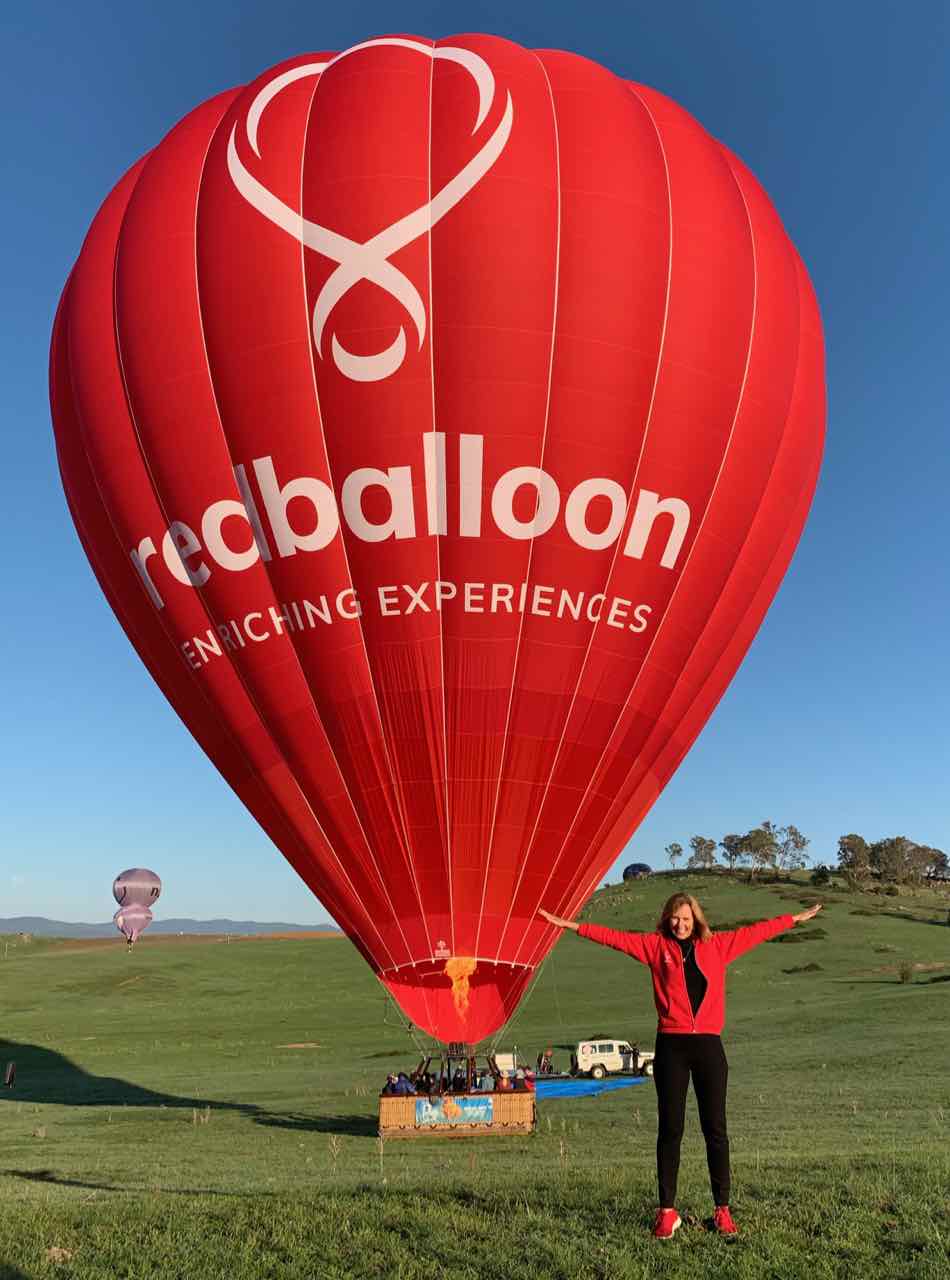
Naomi Simson is the founder and CEO of leading online gift retailer, RedBalloon Days.

Four key elements to authentic leadership

I was asked to speak recently to an audience of women executives on the difference between leadership and management. If you read my blog regularly you will know that I have some very clear ideas about this.

For me, leadership is about bringing every one together with what they have in common – shared vision and values. Management is about nurturing people’s uniqueness as individuals, so that they are doing what they a good at most – contributing their strengths to the greater effort.

I enjoyed listening to Maree Morizzi Head of Consumer Car Loans - Auto Finance Division  ESANDA at this same event on her views on leadership and what it takes. It was interesting that both of us speak of authenticity and being true to yourself. Here are Maree’s thoughts:

“Authentic Leadership - 4 Key Elements - Maree Morizzi

Congruence

  • Congruence is being consistent by 'walking the talk' and leading by example  
  • Being who you are, in every moment and every interaction
  • Doing what you say you are going to do and delivering on promises
  • Standing up for what you believe in

Courage

  • Not being afraid to do away with the sacred cows
  • Being open-minded 
  • Testing new ideas
  • Sailing unchartered waters
  • Being upfront when things don't work

Candor

  • Open, honest, frank communication.  
  • Being straight-up in delivering messages - not sugar coating
  • Calling behaviours that are inconsistent with the values of your business
  • Being completely transparent about what you're doing and why you're doing it
  • Communication that is meaningful and relevant to people

Positive emotion

  • Positive emotion is important in setting tone as the leader - show your passion for what you do
  • Adapting and shifting tone and emotion is important - emotion needs to be relevant to the situation and context
  • Positive emotion enables you to get into the hearts and minds of people”

This is a far more eloquent way of saying “you can’t fake it until you make it”. You have to believe in what you do….and play full out to get it. My mantra as you know is “if it was meant to be it is up to me.” Like wise I cannot do it on my own - and authentic leadership is the way to make it happen.

Shared success

"Success is counted not by how high you have climbed, but by how many people you have brought with you" Anonymous

Top 5 priorities for women - its all about the customer experience.

A recent attitudinal study about women conducted by Marie Claire in the US gives a great insight for marketers. This study confirms what I often blog about regarding brand experience. Is this a women's only issue though?

In partnership with consumer research expert Pam Danziger the study of 1,800 was exploring 'What is on women’s minds?'  'How does she manage her priorities?' 'How do her values impact her role as a consumer?'

“The 5 top priorities for women are:

  1. Emotional Health & Family—Caring and supporting her family is the No. 1 priority at 88%. Her top challenge is finding time to relax, unwind and take care of herself at 61%.
  2. Career & Finances—Achieving financial goals and saving for retirement are tops in this category (78%). Women apply their business acumen to their lives: She is in a constant search for value in her life. She'll pay more—a lot more—for value.
  3. Society & Politics—"Society" category, 80% of women give back to charity financially or with a time commitment.
  4. Health & Wellness—She's busy, she's stressed.  Wellness takes time.  Nearly half (49%) of women surveyed sacrifice sleep as one of her primary time-management strategies.  Women need products and services that help her make time for her health.
  5. Fashion & Beauty— She is an extremely powerful consumer: Her consumer power comes not just from having money, but from knowledge. She invests her time—her most valuable currency—to learn more and to be a smarter person and a smarter shopper.  While her family and her job are very important to her, fashion and beauty are areas that are hers and hers alone.

Overall, marketers have to deliver an experience: Women want more than just a product.  She doesn't need more tangible things in her life, rather she wants a shopping experience that enhances her life.”
 
 "Marketers need to rise to the occasion that this new powerful – and empowered – woman shopper represents.  Marketers and retailers want to build a more meaningful connection with this woman than simply having her as their customer." said Danziger.  "They want more than just a transaction, they want to develop a relationship and the way to do that is to align their marketing and branding messages with her values and priorities."

The question I would pose is “Are women that different than men?  Are men more transactional than women? Or are we all looking for a wonderful brand experience?”
 
About the "All Access Woman" Survey
"All Access Woman" included both qualitative focus groups and quantitative survey methodologies.  The survey was conducted February 15-23, 2008, using an online polling service.  Survey respondents were qualified by reading one of eight leading women's magazines, including Marie Claire, Allure, Elle, Glamour, InStyle, Lucky, Vanity Fair and Vogue. It totalled 1,803 women, with an average age of 37.2 and average household income of approximately $87,500.  Nearly two-thirds of women surveyed were married and 70 percent owned their own home or condominium/apartment.  Some 63 percent were employed full time and 14 percent worked part time.  The survey sample was also highly educated with 64 percent having completed a four year college degree or post-graduate level attainment

The sweetest name is our own.

I read recently that 15% of people are called something they don't like at work - and this (needless to say upsets them.). Okay so you think that I'm stating the obvious.... but knowing people, starts at the very basics. And if employees are the new customers - and we spend a fortune on CRM systems - what do we do about managing our employee relationships - do we have ERM systems?

For each of us we cannot help it - but our name has a sweet sound to it. We like it.

Years ago at Ansett one task I was to arrange a staff gift. I presented a baggage tag - it was beautiful, aluminum with a little leather strap. On one side it was screen printed - "You can't have the greatest airline in the world without the greatest people," on the other their name was engraved. At the time there was not HR department, it was called Personnel, but I thought I would go to payroll to get the names of the people that worked at the airline - they gave me a list, I had the tags engraved, and out they went.

Then they started coming back....People sent back notes with them - 'You still can't spell my name correctly - you never have', 'she hasn't worked here for years', or even 'that is my first name I always use my second name', 'Only my mother calls me that when I am in trouble'.

I was really clear - how could you say that your people are your greatest asset (You can't have the greatest airline in the world wihtout the greatest people.) when you don't even know who works there, nor how to spell their name.

It might sound basic - but getting the name right is a start.

(PS - there is no 'p' in Simson)

Two Australian's on global stage.

Great to pick up the papers this morning and see that two Australian companies - BHP Billiton and Woolworths  have made it to Fortune Magazine's "worlds most admired companies" list.

The SMH reported in relation to the list, "Hay Group, which each year analyses a particular aspect of the findings, this year concentrated its analysis on how companies across the globe managed employee reward programs. It found the companies that made up the most admired lists did a much better job of leveraging reward investments than their contemporaries.

"When the results were limited to Australia and New Zealand, almost half of the surveyed businesses reporting had implemented clear employee reward strategies compared with almost one in six that made up the top 10.

"On the other hand, 86 percent of the top 10 lists had the confidence to recognise well performing staff through reward programs, compared with just under half of Australian and New Zealand companies. Hay Group suggested this could be because local businesses struggled with the tall poppy syndrome.

"Just over one in 10 of the local companies measured return on investment of the reward programs in place compared with just over one in six of the companies that made the lists."  - reporter Adrian Lowe.

Good to know that those who have a formal reward program are reaping the rewards from them, however the numbers indicate that Australia and New Zealand are behind in formal reward programs. I don't agree with Hays that it 's because of a 'tall poppy syndrome' . What we've found is that there is an inertia because organisations know how important it is and there is a fear of  getting it wrong, of failure.

Many businesses know that they must do something - but it get's put off because they're not sure what to do. That's when we say - "call in the professionals". And without wanting to push RedBalloon's barrow too blatantly  - but here's the ad.... That's what we do... we've designed and implementend hundreds of programs...

We just need to get to more companies quicker to support them.

Mr Strengths in Sydney

Marcus Buckingham author “Now discover your strengths” came to town this week.. and it was great to hear from the source. If you are a regular reader you will know that we use strengths tool at RedBalloon.

Here is some of what I got from the session:

“All cultures are local – no matter how large or small the organization in how many locations, this is because culture is a result of individual management styles.”

“People quit bosses.”

“Being a manager is all these things (in no particular order): wisdom, vision, honesty, challenging, caring, trusting, creative, a barometer, motivating, encouraging, determined, inspirational, loyal, belief, values driven, proud, accountable, reliable, ROI focussed, experienced, enthusiastic, and truthful. So it is pretty hard to be a perfect manager – yet there are great managers who are only some of these things… and people resign their bosses.” It is nearly impossible to be all things all the time. There is one question above all else that drives engagement and culture.

“At work do you have the opportunity to do what you do best everyday?”
Then the next most important questions are:
“Do I know what is expected of me at work?”
“Do the people at work have shared values?”

So what percentage of the day do you spend using your strengths (doing what you are good at).

Hence rather than “People are our greatest asset”… “Our people’s strengths are our greatest asset.” After all people can be actively disengaged with their organization which means they are deliberately working against what their colleagues achieve.

Here’s the kick, apparently only 8% of Australians spend the majority (75%) of the day playing to their strengths. No wonder we are the second least engaged workforce on the planet (after the French).

At the end of the event I called on my strengths, woo, input, positivity, connection and self assurance to meet Marcus. I introduced him to our recently appointment Employee Experience manager. I understand he will be back in Australia, and given that 'employees are the new customers' it is well worth seeing him in person.

The risk of doing nothing

"And the day came when the risk it took to remain tight in the bud became greater than the risk it took to blossom"

Anais Nin

At RedBalloon we are currently planning for the new financial year - with the 'painted picture' document as a guide the team is now working out how the business will deliver on the vision. It's so exciting. I love planning - creating the future. The one thing we do know is that the market will change and we must be adaptable to that... to stay doing the same things just will not cut it. We will continue to innovate this year to get were we want to go.

BlogCFC was created by Raymond Camden. This blog is running version 5.8.001.